
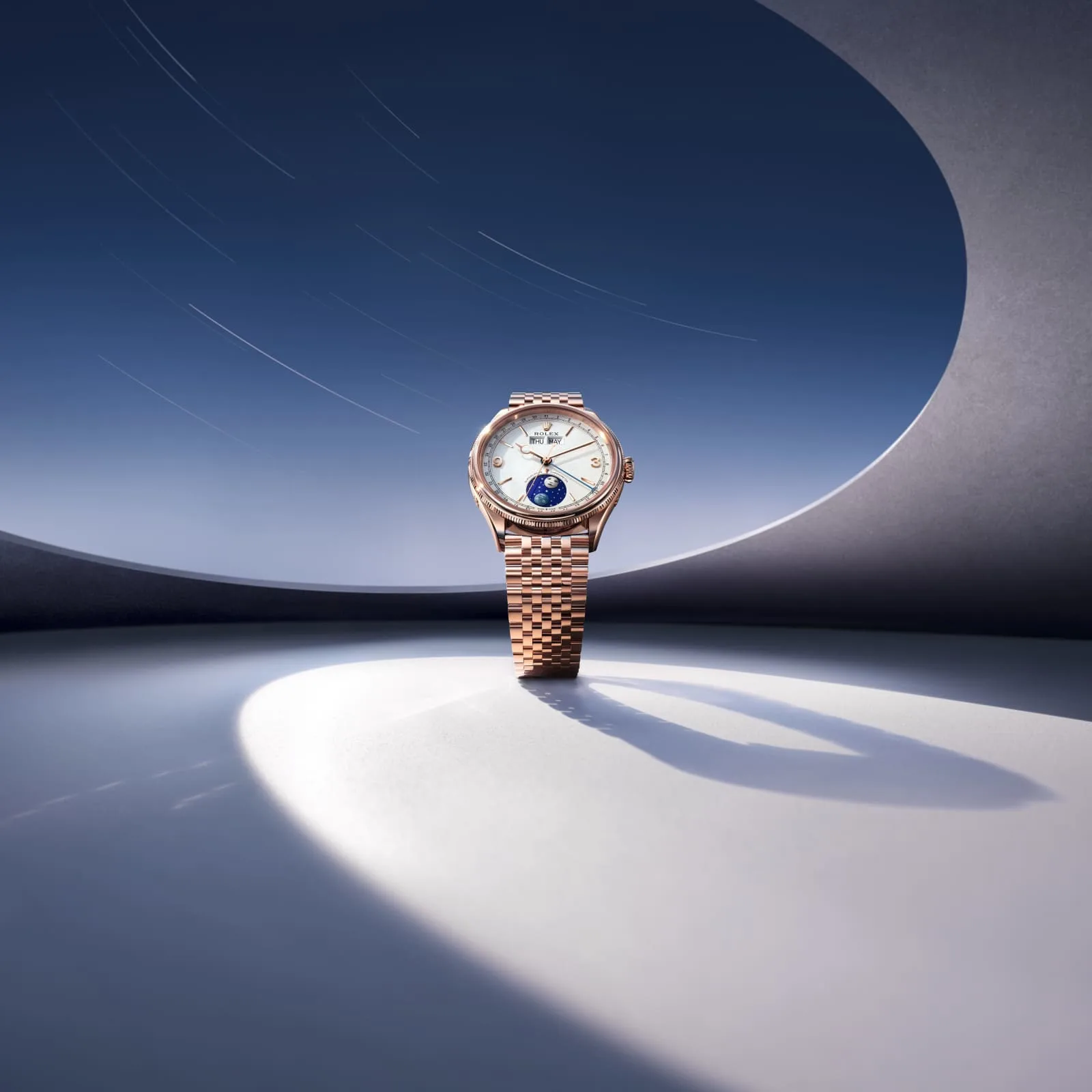
Rolex’s new annual calendar explained: launch references and prices, the Haplos mechanism, moonphase, vintage roots and overlooked details from its patent and owner’s guide.
Rolex’s Perpetual Padellone brings a very different conversation to the brand’s 2026 collection. A calendar watch with a moonphase invites you to look beyond a familiar sports-watch silhouette and consider how a mechanical watch organises an entire month. The most important distinction comes first: this is an annual calendar, not a perpetual calendar. Its name should not be read as a promise that it automatically handles February. Rolex’s announcement confirms that the mechanism distinguishes 30-day and 31-day months, with a correction required as February becomes March. Rolex’s official introduction. Our view is that the interesting story lies in the combination of historical design, contemporary engineering and everyday usability. This guide examines those three strands, then looks at details in the patent record, auction catalogues and owner’s manual that deserve more attention. It is a researched editorial assessment, rather than a claim that we have handled the watch. Information checked on 30 September 2026.
Reference 53505-0002 in Everose gold: the white dial combines twin calendar windows, a blue pointer date and a moonphase display at six o’clock. Official image © Rolex.
Case: 39 mm diameter; launch reporting gives 12.2 mm thickness and 45.1 mm lug-to-lug. Water resistance is 50 metres. Materials: 18 ct Everose gold or 950 platinum. Movement: automatic calibre 7190, operating at 5 Hz, with an approximately 66-hour power reserve. Indications: hours, minutes, central seconds, pointer date, day, month and moonphase. Calendar: instantaneous annual calendar with Rolex’s Haplos system. Presentation: sapphire display back; leather strap or an Everose gold Settimo bracelet, depending on reference. The dimensional figures come from Hodinkee’s launch report; the movement and reserve are detailed in Monochrome’s technical review. Diameter alone cannot settle how a watch will feel. Case thickness, the curve of the lugs, clasp position and the distribution of weight should all be checked during a fitting.
| Reference | Case, dial and attachment | Swiss launch price (incl. tax) |
| 53505-0002 | Everose gold; white dial; brown alligator | CHF 52,500 |
| 53506-0002 | Platinum; ice-blue dial; black alligator | CHF 59,000 |
| 53505-0003 | Everose gold; white dial; Settimo bracelet | CHF 64,800 |
These are Swiss launch prices, reported including tax by Monochrome. They are not UK quotations. We have not independently verified an official sterling retail price, so we have not converted francs into a figure that could be mistaken for Rolex’s UK list price. Confirm current UK pricing and delivery with an authorised retailer. An interesting comparison sits within that list: the Everose bracelet version costs CHF 5,800 more than the platinum strap version. That arithmetic is a useful reminder to compare the complete configuration, not simply rank watches by case metal. It does not establish the standalone price of a bracelet or prove that a later conversion is available.
The twin calendar windows give the top of the dial a clear purpose, while the moon display anchors the lower half. A pointer date uses the circumference instead of adding another rectangular aperture. Visually, that creates a dialogue between the perimeter and the centre: you read the month above, the date around the outside and the lunar cycle below. In the official imagery, the white-dial Everose model offers the warmer, more immediately decorative combination. The platinum version’s ice-blue dial gives a cooler impression. These are aesthetic judgements from the images; colour and reflectivity can change substantially under daylight and indoor lighting. The bracelet deserves its own fitting rather than being treated as an accessory choice at the end. A closely fitted metal bracelet and a leather strap can make the same case feel like two different watches. Ask to assess the clasp under your wrist, movement at the lugs and clearance beneath a shirt cuff. A beautiful dial is only one part of a watch you will enjoy wearing.
Reference 53506-0002 in platinum: an ice-blue dial and black alligator strap give the annual calendar a cooler palette. Official image © Rolex.
Rolex calls the mechanism Haplos. It couples an annual lever and an additional carrier finger to the date mechanism. Those two components are the annual-calendar addition, not the entire movement or every part involved in displaying the calendar. The official explanation also distinguishes the rapid, coordinated changeover from the calculation of month length. Rolex’s technical introduction. Think of two separate jobs. One decides whether the date needs an extra advance at a short month’s end; the other makes the indications change cleanly. At the end of April, the display needs to arrive at 1 May without leaving the wearer to correct a visible 31 April. At an ordinary midnight, the month naturally stays the same. The appeal is practical. An owner who keeps the watch running avoids the repeated end-of-month corrections associated with a simple date mechanism. Someone who changes watches frequently may still need to reset it after it stops. Calendar intelligence and stored running time solve different problems.
Rolex identifies calibre 7190 as an evolution of the Land-Dweller’s 7135. Its technology includes the Dynapulse escapement, a silicon Syloxi hairspring and a ceramic balance staff. The display back exposes a yellow-gold rotor and decorated bridges. Rolex, Calibre 7190. Five hertz means five complete oscillations each second, or 36,000 alternations an hour. That is a frequency specification, not a promise that the watch will keep better time than every slower-beating alternative. Regulation, construction and performance in the finished watch matter as well. There is also an engineering question behind the attractive midnight change: moving several indications at once requires controlled energy delivery. Revolution’s technical analysis describes the calendar’s coordinated release and the handling of the additional advance in short months. The accomplishment is better understood as a system than as a single impressive number. For an owner, the desirable result is a calendar that is clear to read and straightforward to manage.
Calibre 7190: the yellow-gold rotor and decorated bridges are visible through the Padellone’s display back. Official image © Rolex.
“Weekend proof” is often used loosely in watch discussions. Start with the reported 66-hour reserve and an explicit assumption: the watch is fully wound when taken off at 6 pm on Friday. Sixty-six hours takes it to noon on Monday. A full three-day absence is 72 hours, so that falls six hours outside the nominal reserve. This is arithmetic, not a test of an individual watch. A partially wound watch will have less time available, and ordinary wrist wear does not tell you precisely how much energy remains. For someone who alternates between several watches, that distinction may influence ownership more than a movement photograph. Decide whether you are happy to wind and reset a calendar periodically, or whether it will be your regular watch. An annual calendar’s once-a-year scheduled correction assumes uninterrupted running; it cannot keep tracking the date while stopped.
The full and new moons are made from meteorite, set within a blue enamel display. The new-moon material receives a dark-blue PVD treatment, and the lunar faces add a playful detail to an otherwise formal composition. Hodinkee’s close-up report. Retailer Besha’s launch announcement reports a one-day lunar correction interval of 122 years. We distinguish that retailer-reported figure from the specifications explicitly stated in the current Rolex material reviewed here. It should not be read as a servicing interval or a guarantee that an unworn, stopped watch will retain the correct moon display. A moonphase represents a lunar cycle, not the time of moonrise at your address. Its pleasure is partly that it asks you to notice a slower rhythm than the seconds hand. Rolex provides a moon calendar to support setting. That is a more useful ownership link than a dramatic accuracy claim on its own.
The official guide says the calendar correctors may be used in any order and at any time, provided the time has first been set to the correct morning or evening cycle. But there are two practical interactions worth knowing: advancing the date from 31 to 1 also advances the month; changing the month with the date on 31 moves the date to 1, which may then need correcting. The supplied stylus operates the month at 2 o’clock, date at 4, moonphase at 8 and day at 10. Rolex specifies at least 25 clockwise crown turns for adequate partial winding after a stop. It also says not to operate the crown or correctors underwater and to protect a leather strap from water and humidity. Official owner’s guide, setting and care sections. The useful habit is to check the whole calendar after making corrections. Independent controls do not mean that every displayed value is unaffected by every other operation. Ask for a demonstration at handover and keep the guide with the watch’s documents.
The vintage reference 8171 provides more than a memorable nickname. Phillips documented a circa-1950 pink-gold example, 38 mm across, with its retailer guarantee from Giuseppe Avolio & Figlio in Catania and a chronometer certificate dated 13 April 1950. Its catalogue also identifies Favre-Perret as the case maker. Phillips, reference 8171, lot 72. That is a richer historical connection for the modern Everose model than a simple comparison with photographs of yellow-gold or steel watches. Pink gold already belongs to the documented 8171 story. It does not mean the historical alloy was modern Everose, or that the new case is made by the same supplier. Provenance also gives history a human scale: a place of sale, dated paperwork and an identifiable physical object are more informative than an unsupported production estimate. For us, this makes the revival interesting as a continuity of taste as well as an exercise in mechanical design.
A modern launch should not flatten the vintage reference into a single “collectable” category. Phillips’ catalogue for a circa-1951 yellow-gold 8171 emphasises details such as surviving caseback markings and the definition of the case. These are features that can be weakened by polishing. Phillips, reference 8171, lot 74. That changes the questions a buyer should ask. How well is the individual watch documented? Which elements have been restored or replaced? What does the condition report actually establish? Two watches with the same reference can require very different assessments. The new model is therefore not a shortcut for valuing an old one, and an exceptional auction result is not a price guide for every example. The modern watch offers a contemporary interpretation; the vintage watch asks you to evaluate the survival and history of a particular object. Those are separate reasons to collect.
One revealing document is Rolex’s calendar application EP4632499A1. The published record shows a priority date of 10 April 2024, a European filing date of 9 April 2025 and publication on 15 October 2025. These dates are different stages of the application process, not interchangeable launch dates. Published patent record. The useful inference is modest: the documented calendar development predates the Padellone’s 2026 announcement. The record does not establish when a commercial launch was approved, nor does every illustrated patent embodiment necessarily match a production movement. It is also worth preserving Rolex’s wording around its total: 30 patent applications does not mean 30 newly granted patents exclusive to this model. Patent counts are evidence of research activity, not a substitute for understanding how a watch works. The underlying calendar behaviour is more interesting than treating the number as a score.
| Feature | Rolex Perpetual Padellone | Patek Philippe 5396G-017 |
| Calendar | Annual; pointer date | Annual; date aperture |
| Additional display | Moonphase | Moonphase and 24-hour indication |
| Diameter / thickness | 39 / 12.2 mm | 38.5 / 11.2 mm |
| Power reserve | Approximately 66 hours | 35–45 hours |
| Water resistance | 50 metres | 30 metres |
| Frequency | 5 Hz | 4 Hz |
Rolex Sky-Dweller: the travel-oriented comparison. Rolex’s Saros annual calendar is combined with two time zones and the Ring Command setting system. Choose between the two concepts by deciding whether you value a second time zone or a classical calendar-and-moon display more. The Padellone is not Rolex’s first annual calendar. Official Sky-Dweller overview. Rolex 1908: the comparison for someone chiefly attracted to a refined Rolex dress watch. Its simpler time display makes a useful visual counterpoint. If you enjoy an open, quieter dial, extra calendar information is not automatically an improvement. Compare the two with your own clothes and daily routine rather than assuming more functions mean a better choice. Official 1908 collection. Patek Philippe 5396G-017: a direct annual-calendar and moonphase alternative. Patek lists a 38.5 mm case, 11.2 mm thickness, 30-metre water resistance and a 35–45-hour reserve. It also has a 24-hour indication and uses apertures for the date as well as day and month. Patek dates its annual-calendar invention to 1996. Official 5396G-017 specifications. These differences make a useful fitting shortlist; they do not produce an automatic winner. Readability, tactile operation, proportions and enjoyment should carry more weight than awarding points for one extra millimetre or hour.
The strongest reason to consider the Padellone is that you enjoy its particular combination of calendar information and design. A purchase based only on novelty risks overlooking the everyday experience that follows the first week. Ask to see the exact reference, confirm the complete contents supplied and have every setting operation demonstrated. Compare bracelet fit with strap fit, check dial legibility without magnification and establish the current price and delivery terms in writing. If evaluating a pre-owned example later, distinguish the manufacturer’s documents from a dealer’s own inspection and warranty. We would also separate enthusiasm for the launch from predictions about resale. At this early stage, a confident story about future premiums would tell you more about speculation than about the watch itself. The better question is whether this is the calendar you would still want to wear once the announcement is no longer news. You can explore Finer Lux’s Rolex collection or speak to our team about comparing available pre-owned pieces. This article does not imply that the new Padellone is currently in our stock.
Is the Perpetual Padellone a perpetual calendar? No. It is an annual calendar. February still needs a manual correction when moving into March. Does it need correcting only once a year? That describes the calendar’s scheduled correction while it keeps running. A stop can require additional setting. Can I use the Swiss prices as UK retail prices? No. The figures above are clearly identified Swiss launch prices. Obtain a current UK quotation for the exact reference. What should I check when choosing strap or bracelet? Try the complete watch, including its clasp. Confirm sizing, supplied components and any replacement options with the seller rather than assuming interchangeability. Is it a replacement for buying a vintage 8171? They address different interests. The modern model is a contemporary calendar watch; a vintage 8171 is an individual historical object whose condition and provenance require separate scrutiny.
Research and image credits: official Rolex announcement and owner’s guide; published European patent record; Phillips auction catalogues; official Patek Philippe specifications; launch reporting by Hodinkee, Monochrome and Revolution; Besha retailer announcement. Sources are linked beside the relevant discussion. Cover image © Rolex. Finer Lux is an independent watch and jewellery dealer and is not affiliated with Rolex.
11/10/2026·Finer Lux
Explore new AP jewellery, Royal Oak cuffs, necklaces and earrings, UK prices, exact references and the history of Audemars Piguet jewellery.

30/09/2026·Kaitlyn Dotson
The Royal Oak Serena Williams edition pairs white ceramic with a pink mother-of-pearl dial. Explore reference 26450CB.OO.1356CB.02, its £75,500 UK indicative price and Calibre 6401.
10/08/2026·Kaitlyn Dotson
Thinking about servicing your Patek Philippe? From a simple strap change to a full complication overhaul, here's what owners can expect to pay in the UK — broken down by service type, with real-world examples of which models typically need each one.

26/06/2026·Kaitlyn Dotson
The tachymeter is the scale most people notice on a chronograph and the one fewest know how to use. Here is how it actually works, what the numbers mean, and the racing history that made it the signature of the Rolex Daytona.

23/06/2026·Kaitlyn Dotson
Every summer the world's oldest tennis tournament turns a corner of south west London a vivid shade of green, and on the wrist of its champions sits a crown. This is the story of Rolex and Wimbledon, the slate and green Datejust collectors prize, and what one costs today in sterling.

11/06/2026·Kaitlyn Dotson
Rolex built its reputation on precision, prestige, and performance. Yet scattered throughout the brand's century-long history are watches so unusual, so experimental, or so short-lived that even seasoned collectors do a double-take. From a Rolex powered by a quartz movement to dials painted in colours that look lifted from a Caribbean sunset, these are the watches that tell a very different story about one of the world's great watchmakers.

29/05/2026·Kaitlyn Dotson
Following the official price update effective February 2026, a modern Rolex costs between £550 and £780 to service, classic five digit references run from £830 to £1,190, and vintage four digit pieces range from £1,380 to £7,350. Every official overhaul also includes a two year guarantee. Full official price tables, likely extra part costs, and what the service involves are all below.

21/05/2026·Kaitlyn Dotson
Cartier has lifted its US watch prices as of 21 May 2026, with most icons climbing around 14–18% on top-end gold and diamond-set models. Here's exactly what's changing, why it's happening, which watches feel it most, whether the jewellery could be next, and why the smart money may already be looking at the pre-owned counter rather than the boutique window.

19/05/2026·Kaitlyn Dotson
Audemars Piguet has quietly done something it has never done in fifty years — licensed the Royal Oak's design language to another watchmaker. Gone is the assumption that the octagonal bezel and eight hexagonal screws belong only to Le Brassus. In its place is the Royal Pop, eight Bioceramic pocket watches launched with Swatch that triggered 300-person queues, store closures, and £15,000 eBay asks within hours. If you're wondering whether to chase one, the picture three days later is very different from launch day.

28/04/2026·Kaitlyn Dotson
Rolex has quietly changed the documents that prove a watch is real. The 2026 warranty card and hang tag now share a green wood-grain finish, joined by a hidden line of defence against counterfeiters. Here is what changed, why it matters, and how to read the new set.

24/04/2026·Kaitlyn Dotson
Around Watches & Wonders Geneva 2026, Rolex quietly introduced four gem-set Cosmograph Daytona references that won't appear on any website, won't be shown to journalists, and won't be offered to walk-in clients. References 126595SARO, 126596SABV, 126598TML, and 126599SAVL, each built around a different precious metal and an entirely distinct colour story, are among the most significant Daytona releases in years.

